.jpg?disposition=inline)
Our Challenge
Karamoja is a resource-strained region in northeastern Uganda, characterized as a semi-arid area predominantly inhabited by pastoral communities. It is home to approximately 1.5 million. Currently, over 70% of the population live below the poverty line – over three times the national average of 20.3%.
The region is also highly associated with chronic food insecurity. According to a recent study by the Integrated Food Security Phase Classification (IPC, 2026), nearly 1 in 3 of the studied population experience acute food insecurity. Severe acute malnutrition affects roughly 2.4% of the children under-five population region-wide.
Driven by severe food insecurity, communities are forced to adopt negative coping mechanisms such as charcoal production, firewood sale, and unregulated mining which systematically degrade fragile ecosystems, destroy wildlife habitats, disrupt soil structures, and severely amplify the impacts of climate change.
Our Approach
What if children as early as 7 years in rural schools could learn not only about agriculture, but also how to read a landscape, understand water movement and degradation of soils, protect biodiversity, and design farms that are better able to withstand climate pressures?
This is one unique question driving the Rural Schools’ Agroecology Programme of Rural Agroecology Network.
Recognizing the need for urgent action, in August 2025, we introduced agroecology into rural schools in Karamoja, piloting with one school in Abim district—birthing our schools’ Agroecology Initiative. This initiative is uniquely designed to fill a critical gap in Uganda’s education by addressing the current lack of environmental (agro-ecological) information among young learners.
We recognize and empower children not just as the next generation, but as active climate resilience leaders of today and tomorrow.
Learning to Read the Land
Soon after we introduced agroecology into schools, two of our members participated in the October 2025 RD Training-of-Trainers Certification program at African Women Rising’s Lok Neno Training, Demonstration and Research Site in Palabek Refugee Settlement.

Akech Eshter Lona, an Assistant Agronomist who attended the training, shared: “The training provided me with practical hands-on knowledge and enabled me to demonstrate to farmers and school-going children how regenerative production can restore their landscapes, ecosystems' biodiversity, prolonged dry spell risks, while also sustainably improving nutrition and overall food security for their households through regenerative agriculture."
Following the ToT, RAN organized RD training sessions with the learners at Alerek Primary school. “The training has helped me to empower our rural farmers to adopt regenerative practices, improve soil health, and boost crop productivity. After training, together with the local communities, we were able to co-create an RD learning site at Alerek Primary School, improving access to RD training and adoption,” shared Owiny Shadrack Ojuma, RAN Environment & Natural Resources Officer.
One of the first practical skills introduced to the learners was the use of an A-frame, a simple farm tool that helps determine the slope of land. Rather than simply being taught how to use the tool, learners participated in the process themselves.
They learned how to make the A-frame from local materials, calibrate it, and take measurements—then used it to understand how information about the landscape can guide the design of a highly resilient farm with strong water harvesting structures, soil restoration techniques and variety of biodiversity, forming a sustainable regenerative farming system.
This seemingly simple skill opens up a much bigger way of thinking.
Understanding land slope helps learners appreciate how water moves across a landscape and how farming structures can be positioned to slow runoff, conserve soil and improve water infiltration.
For RAN, this is an important foundation for introducing children to Resilience Design: before changing the landscape, learn to observe and understand it.
We see enormous potential in connecting education, agroecology and Resilience Design: the rural schools of today can become the learning grounds for the resilient food systems of tomorrow.

Watch Mercy Hope Acheng explain how to build a single-dug bed.
Turning Water into an Opportunity
The second practical session involved the school children learning how to establish half-moon beds, a simple semi-circular structure designed to capture and retain rainwater, slow surface runoff and increase water infiltration into the soil. The exercise brought together several principles of Resilience Design: water harvesting, building living soils, landscape restoration, strengthening biodiversity–all in service of sustainable food production.
Through this hands-on activity, the learners were able to connect classroom knowledge with a practical solution for managing water in their own environment. They worked together to shape the beds, understanding how these structures can help restore degraded soils, conserve moisture during prolonged dry spells and create better conditions for crops and vegetation to thrive.

For communities experiencing increasingly erratic rainfall, such approaches can provide an affordable way of slowing, spreading, sinking and saving water to support crop growth and soil restoration. Constructing the half-moons at the school provides learners with an opportunity to observe their performance over time and continue learning from the landscape.
The learning was not simply delivered by an adult instructor to passive students: the learners themselves became part of the teaching and learning process.
What This Means to Us
Watching the children actively participate and learn is one of the most inspiring and exciting parts of our work.
We believe children should not only be prepared to become farmers in the future – they should be equipped to become land stewards, environmental leaders and innovators at a young age, while they are still in school.
-
.jpg) Students preparing land for half-moon berm construction. Credit: Rural Agroecology Network
Students preparing land for half-moon berm construction. Credit: Rural Agroecology Network -
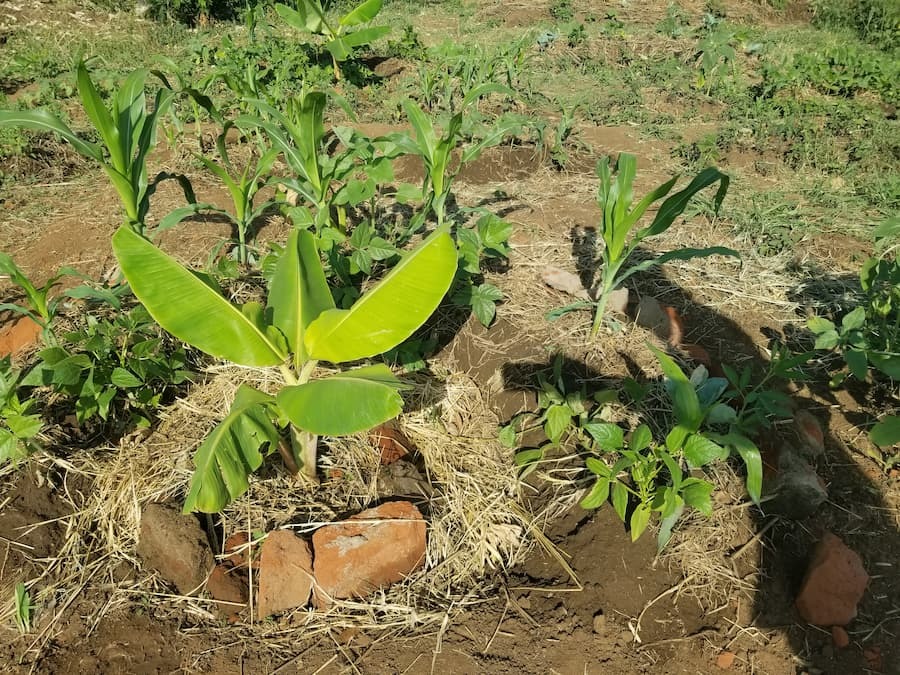 A range of biodiversity growing at the Alerek Primary School RD site. Credit: Rural Agroecology Network
 -
.jpg) Students prepare double-dug planting beds. Credit: Rural Agroecology Network
Students prepare double-dug planting beds. Credit: Rural Agroecology Network
When children learn to see the land not simply as a place to produce food, but as a living system that must be understood and regenerated, we begin to cultivate the environmental stewards and resilient food systems leaders our communities need.
Next Steps
Our next step is to support the students to share the knowledge and skills to the different communities they come from.
We have learned that age does not have to be a barrier to understanding regenerative agriculture. When learning is practical and participatory, children can confidently explain what they have learned and demonstrate it to others.

Growing a Generation of Resilience Champions
Through the Rural Schools' Agroecology Programme, we are nurturing young people with practical knowledge that can remain with them throughout their lives, from understanding land slope and water movement to restoring soils, conserving biodiversity and producing food sustainably.
Our vision extends beyond establishing half-moons or teaching children how to use an A-frame. It is about nurturing a different relationship between young people and the land: one rooted in observation, care, regeneration and responsibility.
For us, resilience begins with learning, and sometimes, it begins with a child holding an A-frame and learning to read the land.

About Rural Agroecology Network and the Rural Schools’ Agroecology Programme
Rural Agroecology Network (RAN) is a youth-led Indigenous Peoples’ organization working to advance agroecology, regenerative agriculture, biodiversity conservation, food sovereignty and resilient rural livelihoods in Uganda.
Through its Rural Schools’ Agroecology Programme, RAN creates practical learning opportunities for school-going children to understand and apply agroecological and Resilience Design Regenerative Agriculture approaches. The programme connects classroom learning with hands-on activities such as water harvesting, soil conservation, agroforestry, biodiversity restoration and regenerative farming, helping nurture a generation of young environmental stewards and food systems leaders.
To learn more: