.jpeg?disposition=inline)
Climate change is no longer a distant threat in Somalia—it is shaping daily realities through prolonged droughts, degraded land, and increasing pressure on fragile livelihoods. For many communities, these impacts are felt most sharply in reduced food security, forced displacement, and growing competition over scarce natural resources.
A three-day workshop from 18–20 May 2026—conducted in Athi River, Kenya—brought together government representatives from Somalia, academics, civil society actors, and development partners—each carrying a shared concern and a common determination to find practical solutions to the climate challenges facing Somalia.
Convened by IOM Somalia and the United Nations Environment Programme (UNEP), the Regenerative Resilience Design Workshop focused on a central question: How can climate challenges be addressed through nature-based solutions that help communities not only survive shocks, but rebuild stronger, healthier, and more self-reliant?
Using nature as the classroom

Using the Resilience Design approach as a connecting theme, the workshop moved between technical exchanges and hands-on learning. Rather than remaining in abstract policy discussions, government officials, academics, and development partners walked frequently into the field together to explore regenerative Resilience Design and ecosystem restoration concepts.
The discussions kept returning to one reality: effective nature-based solutions must be designed with and for the affected communities. Only then can solutions be tailored to address the needs of the community and sustained over time.
Resilience Design should be part of the work we are doing in Somalia when it comes to climate and environment issue. Bringing all the entities together helps understand the country better. Through policy and implementation, we could achieve a lot together.
-
 (1).jpg) Participants learn to build and calibrate an A-frame level. Credit: IOM 2026
Participants learn to build and calibrate an A-frame level. Credit: IOM 2026 -
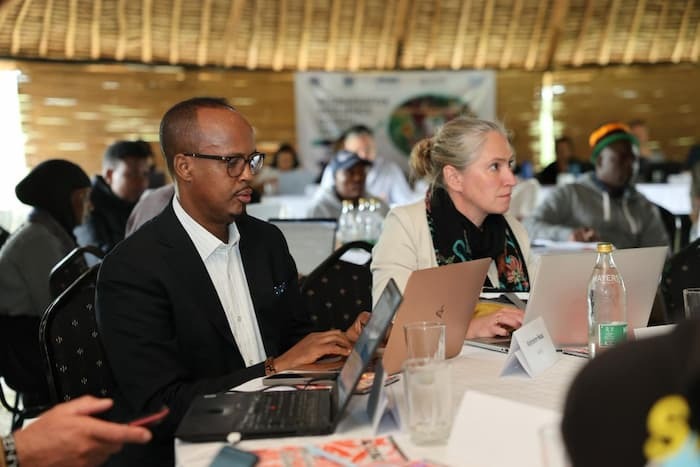 The workshop included technical presentations on Resilience Design, alongside the practical exercises. Credit: IOM 2026
Emerging collaborations
Participants began identifying pathways for integrating climate-smart, nature-based solutions into environmental restoration efforts in Somalia – such as using nature-based bioengineering to strengthen vulnerable riverbanks, reduce flood risks and protect communities and agricultural land, as demonstrated through JOSP in Jowhar.
Attention also turned to where collaboration across sectors and actors could have the greatest impact. In a context where climate change and fragility are deeply intertwined, the workshop highlighted the importance of bringing different actors and investments together around a shared vision for resilience.

The participation of vertical climate and environmental funds was particularly valuable in this regard. Their strong interest in regenerative Resilience Design as a common approach for advancing nature-based solutions, ecosystem restoration, and climate action pointed to an important opportunity: aligning efforts to bring greater coherence across investments and build a more integrated approach to resilience in Somalia.
The way forward
What emerged in Athi River was not a final blueprint, but a stronger sense of alignment and shared purpose: a commitment to locally led, environmentally sustainable solutions that connect ecosystem restoration with human recovery.
The workshop laid the groundwork for continued collaboration, shared learning, and practical action—connecting policy, financing, and implementation to support communities and ecosystems facing growing climate and environmental pressures.

About UNEP and IOM Somalia
The International Organization for Migration (IOM) is the United Nation’s leading agency on migration and the leading intergovernmental organization in the field of migration, working closely with its key stakeholders - migrants and Member States - to promote humane, safe, and orderly migration. It does so by providing services and advice to governments and migrants from an integral and holistic perspective, including links to development, to maximize the benefits and opportunities of migration and reduce its challenges. IOM is committed to meeting humanitarian needs while reducing risks and vulnerabilities, with a long-term view towards reducing and ultimately ending humanitarian needs. It reinforces partnerships with governments, NGOs and civil society organizations based on the shared principles, strengthens local capacities, while contributing to collective efforts to advance the operationalization of the triple nexus—Humanitarian, Development and Peace. Learn more at https://somalia.iom.int/.
The United Nations Environment Programme (UNEP) is the United Nations’ leading global authority on the environment, driving transformational change on the triple planetary crisis: the crisis of climate change, the crisis of nature, land and biodiversity loss, and the crisis of pollution and waste. Since its founding in 1972, UNEP has served as a neutral convener of Member States, civil society, the private sector and UN agencies to address the most pressing environmental challenges, working with its 193 Member States to support the achievement of the Sustainable Development Goals. Learn more at www.unep.org.